
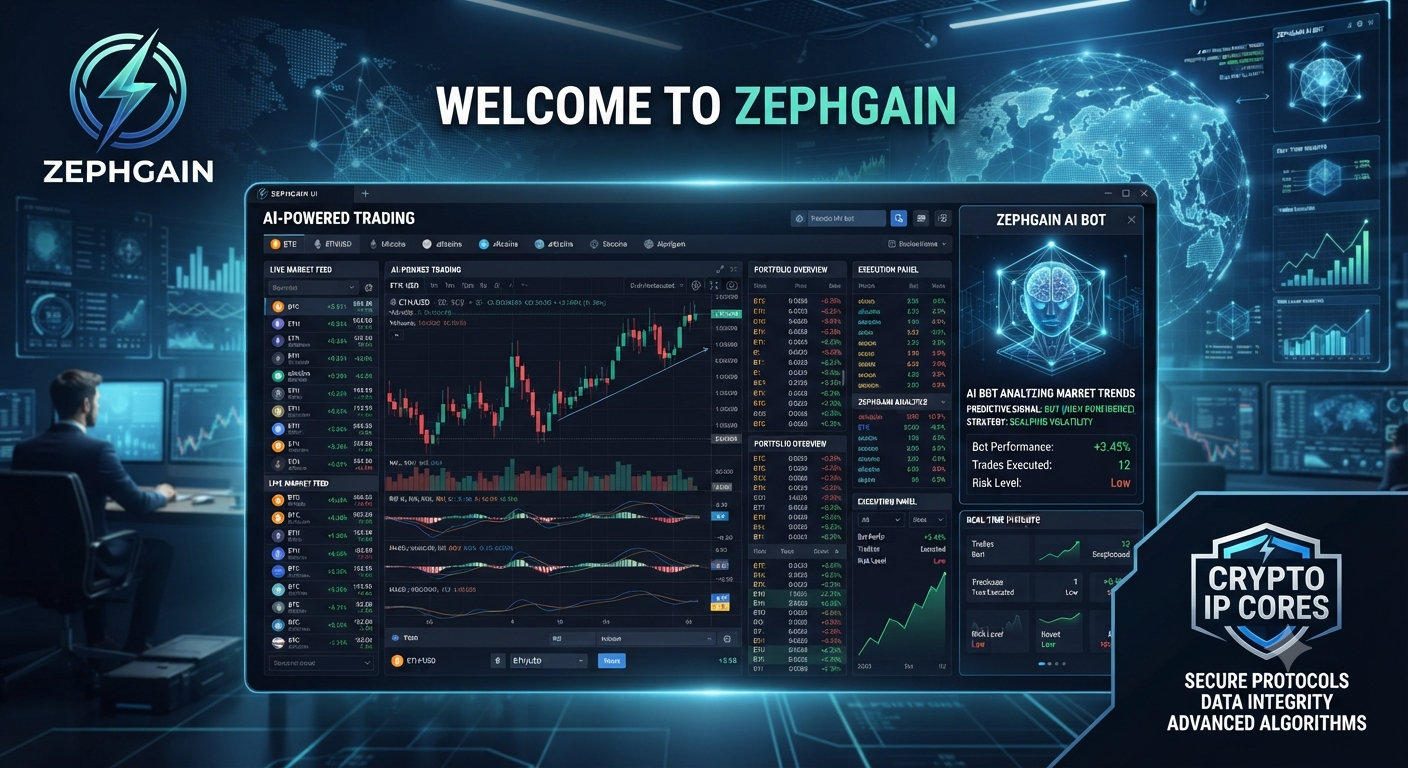
The digital asset market operates continuously across global liquidity pools, characterized by rapid price swings, fragmentation across decentralized and centralized exchanges, and complex order-book dynamics. For both individual retail traders and sophisticated crypto investors, capitalizing on intraday volatility in Bitcoin, Ethereum, and emerging altcoin ecosystems requires more than manual chart scanning. The modern crypto landscape demands computational speed, data-driven sentiment analysis, and automated execution engines that can react to structural market shifts in milliseconds.
In recent years, the convergence of quantitative trading methodologies and machine-learning algorithms has transformed retail crypto access. Traders no longer rely solely on basic limit or market orders executed via conventional order-routing interfaces. Instead, the focus has shifted toward unified algorithmic ecosystems that monitor multi-timeframe indicators, track funding rate arbitrage, analyze volume profiles, and execute rules-based strategies without human emotional bias.
Zephgain has emerged within this automated trading vertical as a crypto-focused execution platform designed to bridge the gap between institutional-grade quantitative modeling and user-friendly interface design. By synthesizing real-time market data, technical indicator overlays, and automated order placement, the platform aims to streamline how traders interact with volatile cryptocurrency pairs and derivatives.
👉 Start Crypto Algorithmic Trading With Zephgain – Activate Your Account With a $250 Deposit
What Is Zephgain? Architecting a Next-Gen Crypto Trading Engine
Zephgain is an algorithmic and manual cryptocurrency trading platform that integrates automated market scanning, predictive pricing models, and multi-asset execution within a single web-based dashboard. Unlike passive crypto buy-and-hold wallets or simple spot-trading applications, Zephgain is engineered for active traders seeking to capture momentum, swing-trading opportunities, and algorithmic breakouts across major digital assets.
At its technical core, the platform acts as an intelligent execution layer. It processes market data—such as order-book depth, tick-by-tick transaction volumes, moving averages, and relative strength imbalances—to identify probabilistic trade setups. Once an opportunity aligns with the user’s predefined risk parameters, the engine either triggers a real-time notification for manual approval or autonomously enters and manages the position through execution automation.
Key Technical Pillars of the Platform
-
Algorithmic Opportunity Recognition: Employs continuous pattern-recognition protocols to detect liquidity sweeps, Fibonacci retracements, and breakout structures across Bitcoin and altcoin trading pairs.
-
Hybrid Execution Architecture: Allows users to alternate between full automation—where algorithmic systems enter and exit trades—and precision manual trading with charting overlays.
-
Zero-Installation Web Infrastructure: Hosted as a responsive cloud-based platform accessible across desktop systems, tablets, and mobile devices without requiring localized software installations or continuous background processing.
-
Unified Multi-Asset Access: Connects crypto market volatility with secondary exposure to traditional financial instruments, enabling traders to hedge digital asset portfolios against macroeconomic shifts.
Core Technology & Algorithmic Execution Mechanics
The primary differentiator of any algorithmic crypto platform lies in its back-end execution logic and latency reduction. In fast-moving cryptocurrency markets, a delay of even half a second can result in significant slippage, particularly when entering or exiting leveraged positions during liquidity events.
1. Data Aggregation & Price Discovery
Zephgain aggregates pricing feeds across multiple high-liquidity cryptocurrency venues. By monitoring consolidated bid-ask spreads and order-book depth, the system ensures that market execution reflects fair real-time valuation rather than isolated exchange spikes. This consolidated tape feed allows the platform’s analytical engine to calculate weighted average prices and identify genuine breakout volume versus spoofed order-book liquidity.
2. Algorithmic Pattern Recognition
The platform’s analytical engine continuously runs mathematical evaluations against historical and live market data. Core computational models include:
-
Momentum & Reversal Detection: Tracking Relative Strength Index (RSI), Moving Average Convergence Divergence (MACD), and Stochastic Oscillators across 5-minute, 1-hour, and daily charts to flag overbought or oversold conditions.
-
Volatility Band Analysis: Using Bollinger Bands and Average True Range (ATR) to measure volatility expansion, identifying optimal entry zones when altcoins break out of consolidation channels.
-
Trend-Following Filters: Applying Exponential Moving Averages (EMA 20, 50, 200) to ensure automated strategies align with macro market structure rather than fighting dominant trend directions.
3. Automated Order Management & Slippage Mitigation
When an algorithmic strategy initiates a trade, the execution engine deploys order-routing mechanisms designed to minimize market impact:
-
Precision Entry Sequencing: Orders are routed with strict limit-price parameters to prevent filling at unfavorable prices during sudden volatility spikes.
-
Dynamic Stop-Loss Adjustments: The system can automatically trail stop-loss thresholds as a cryptocurrency moves into profit, locking in gains while leaving upward momentum open.
-
Split-Order Execution: For larger position sizes, the engine can break orders into smaller tranches to absorb liquidity smoothly without alerting market participants or triggering slippage.
🚀 Claim Your Zephgain Crypto Account – Execute Smart Bitcoin & Altcoin Trades Today
Supported Cryptocurrency Assets & Market Liquidity
A successful crypto trading strategy requires access to both foundational, high-liquidity digital assets and higher-beta altcoins that exhibit significant percentage moves during altcoin seasons. Zephgain provides a diversified asset catalog structured around major crypto market sectors.
| Asset Layer | Featured Cryptocurrencies | Trading Characteristics | Best Suited For |
| Large-Cap Foundational | Bitcoin (BTC), Ethereum (ETH) | High liquidity, tight bid-ask spreads, institutional volume | Trend following, macro hedging, core portfolio allocation |
| Layer-1 Infrastructure | Solana (SOL), Cardano (ADA), Polkadot (DOT), Avalanche (AVAX) | Strong cyclical momentum, high beta relative to Bitcoin | Breakout strategies, swing trading, volatility capture |
| Decentralized Finance (DeFi) | Chainlink (LINK), Uniswap (UNI), Aave (AAVE) | Highly responsive to protocol updates and ecosystem volume | Sector-specific momentum trading |
| Cross-Border Payments | Ripple (XRP), Litecoin (LTC) | Distinct chart patterns, rapid liquidity surges | Intraday momentum breakouts |
| Traditional Hedging Assets | Forex Pairs, Major Indices, Gold, Energy Commodities | Stable correlation profiles against crypto cycles | Multi-asset portfolio balancing and risk mitigation |
By maintaining access to both cryptocurrency markets and traditional financial instruments, traders can execute cross-asset arbitrage or shift capital into defensive assets (like Gold or indices) during broader crypto bear markets without leaving the platform ecosystem.
Manual Trading vs. AI-Driven Algorithmic Automation
One of the most critical decisions for any crypto trader using Zephgain is selecting the appropriate operational mode. The platform accommodates both discretionary traders who want direct control over every order and systematic traders who prefer rules-based automation.
The Case for Algorithmic Automation
Cryptocurrency markets never close. Important price movements frequently occur during Asian, European, or US trading overlaps when an individual trader may be asleep or offline. Algorithmic automation solves this structural challenge by maintaining a continuous operational loop:
-
Elimination of Emotional Interference: Human traders frequently fall victim to FOMO (Fear of Missing Out) during parabolic green candles or panic-sell during routine market flash crashes. Automated systems execute strictly according to numerical parameters.
-
Continuous Multi-Pair Surveillance: While a human can track two or three charts effectively, an automated engine can monitor twenty cryptocurrency pairs simultaneously, executing setups the second technical conditions are met.
-
Speed of Execution: Algorithmic execution removes human reaction latency, placing take-profit and stop-loss orders in milliseconds as target price thresholds are breached.
The Case for Manual Execution
Despite the speed of automation, manual trading remains essential during high-impact market events:
-
Macroeconomic News Events: Central bank interest rate decisions, regulatory announcements, or unexpected geopolitical shifts can invalidate technical chart patterns instantly. Manual traders can step aside or adjust leverage manually before liquidity evaporates.
-
Discretionary Pattern Recognition: Experienced traders often recognize structural market context—such as low-volume weekend manipulation or exchange maintenance schedules—that rigid algorithms might misinterpret as genuine breakouts.
-
Custom Strategy Testing: Traders can use manual execution to refine entry levels on smaller position sizes before converting the strategy into an automated rule set.
👉 Start Crypto Algorithmic Trading With Zephgain – Activate Your Account With a $250 Deposit
Security Architecture: Asset Protection, Encryption & Compliance Standards
In the cryptocurrency industry, security infrastructure is just as important as execution speed. Decentralized and digital assets attract continuous adversarial attempts, making platform security a mandatory requirement for capital preservation. Zephgain structures its defensive layer around modern data encryption, secure authentication, and segregated operational protocols.
1. Transport Layer Security & Data Encryption
All data transmitted between the user’s device and the Zephgain servers is protected using 256-bit SSL encryption. This ensures that login credentials, API authorizations, and personal financial details are obfuscated against man-in-the-middle attacks, DNS spoofing, and network interception.
2. Multi-Factor Authentication (MFA)
To guard against unauthorized account access, Zephgain requires users to enable Multi-Factor Authentication. Account logins, withdrawals, and changes to sensitive security settings require time-sensitive cryptographic tokens generated via secure mobile authentication apps, preventing credential-stuffing exploits.
3. Strict Verification & Compliance Frameworks
To maintain institutional trust and prevent illicit financial flows, the platform adheres to standard Anti-Money Laundering (AML) and Know Your Customer (KYC) onboarding protocols. Identity verification checks ensure that all platform participants are authenticated, protecting the ecosystem from wash-trading networks and fraudulent accounts.
4. Segregated Capital Management
User funds and operational capital are treated as distinct financial flows. Trading capital deposited by users is maintained in segregated accounts with Tier-1 liquidity providers and regulated banking partners, ensuring that user balances remain insulated from internal company operations.
⚡ Explore Zephgain AI Market Insights – Diversify Your Crypto Portfolio Today
Step-by-Step Onboarding: How to Deploy Your Zephgain Trading Account
Entering the cryptocurrency market through Zephgain requires a structured setup process. To ensure proper risk management and algorithmic calibration, follow this sequential deployment guide:
Step 1: Complete Account Registration
Navigate to the official Zephgain portal and access the registration interface. Enter a primary email address, your full legal name, and a secure contact telephone number. Use an alphanumeric password combining uppercase letters, numerals, and special characters to establish primary account security.
Step 2: Identity Verification & Account Activation
Check your registered email inbox for the cryptographic confirmation link. Once verified, complete the required onboarding identity checks by submitting a government-issued identification document (such as a passport or driver’s license). Verification is typically processed rapidly, granting full access to trading infrastructure.
Step 3: Fund Your Trading Account ($250 Minimum Capital)
To activate the algorithmic engine and access live market liquidity, deposit the baseline trading capital of $250. This deposit is not a subscription or platform fee; it remains entirely your trading equity to deploy across Bitcoin, altcoins, and multi-asset pairs. Funding methods typically include credit/debit processing, wire transfers, and supported digital asset transfers.
Step 4: Calibrate the Trading Workspace
Upon logging into the dashboard, customize your charting layouts. Add essential cryptocurrency technical indicators such as:
-
200-period Exponential Moving Average (EMA): For defining long-term bullish or bearish market structure.
-
Volume Profile: To identify high-liquidity support and resistance zones.
-
Average True Range (ATR): To calibrate stop-loss distances based on current asset volatility.
Step 5: Select Your Execution Mode & Risk Rules
Decide whether to deploy autonomous algorithmic strategies or trade manually. If selecting Automated Mode:
-
Define the maximum capital allocation per trade (recommended: 1% to 2% of total account equity).
-
Set your daily drawdown limit (e.g., halting trading if the account experiences a 5% drop in a single session).
-
Select target crypto pairs based on liquidity and daily trading volume.
Step 6: Initiate Trading & Monitor Metrics
Activate your automated rules or execute your first manual position. Use the analytics dashboard to review real-time trade logs, win/loss ratios, average holding times, and net profitability across different market sessions.
Fee Structure, Capital Requirements & Transparency Breakdown
Unexpected transaction costs, excessive funding rates, and hidden account fees can erode profitability over hundreds of algorithmic trades. Zephgain maintains a straightforward fee structure designed to preserve trader margins.
| Cost Category | Fee Structure / Policy | Practical Impact on Crypto Traders |
| Account Opening & Registration | $0.00 (Free) | No upfront costs to access platform layouts and charting tools |
| Minimum Initial Deposit | $250 USD | Functions entirely as your accessible trading balance |
| Trading Spreads (Bid-Ask) | Competitive Market Spreads | Tight bid-ask differences on BTC/USD and ETH/USD, minimizing entry friction |
| Software Subscription Fees | None | All automated algorithms and analytics are included without monthly recurring charges |
| Deposit & Withdrawal Processing | No Hidden Platform Markup | Transparent processing fees depending on payment provider or blockchain network gas fees |
| Inactivity Fees | Standard Activity Terms | Designed for active traders; users should review terms regarding prolonged account dormancy |
Why the $250 Minimum Deposit Matters
In quantitative crypto trading, algorithms require sufficient margin to manage volatility without triggering premature stop-outs. A $250 initial capital allocation provides the mathematical headroom required to:
-
Divide capital across 5 to 10 distinct altcoin positions simultaneously.
-
Absorb normal intraday crypto fluctuations (3% to 7%) without breaching margin maintenance limits.
-
Test automated strategy performance with meaningful real-world liquidity before scaling up capital.
🔒 Open Your Secure Zephgain Account – Access Next-Gen Crypto Automation Now
Advanced Crypto Trading Strategies with Zephgain
Once an account is funded and configured, traders can implement structured crypto trading strategies suited to Zephgain’s algorithmic capabilities.
1. Altcoin Momentum Breakout Strategy
Altcoins often consolidate within narrow horizontal price channels before experiencing sudden, volume-driven breakouts.
-
Setup: The algorithm scans the top 20 altcoins by volume for assets trading within a tighter-than-average Bollinger Band squeeze.
-
Execution Rule: When an altcoin’s price breaks above the upper Bollinger Band accompanied by a 50% increase in hourly volume, the system triggers a long entry.
-
Risk Management: A trailing stop-loss is automatically set at the 20-period Exponential Moving Average (EMA) to ride the trend until momentum exhaustively breaks.
2. Bitcoin Range-Reversion Strategy
During periods of low macroeconomic news, Bitcoin often trades in predictable horizontal ranges between well-defined support and resistance levels.
-
Setup: Define the upper resistance and lower support levels of the BTC/USD range on the 4-hour chart.
-
Execution Rule: When BTC touches support and the Relative Strength Index (RSI) drops below 30 (oversold), the algorithm executes a long position. Conversely, when BTC reaches upper resistance with an RSI above 70 (overbought), it executes a short position or exits longs.
-
Risk Management: Hard stop-loss placed 1.5% outside the established channel range to protect against sudden structural breakouts.
3. Cross-Asset Hedging Strategy
When cryptocurrency markets experience a broad market sell-off, correlation across digital assets approaches 1.0 (everything drops simultaneously).
-
Setup: Monitor Bitcoin’s daily moving average trend.
-
Execution Rule: If Bitcoin breaks below its 200-day moving average on high volume, the automated engine reduces exposure to high-beta altcoins and allocates a percentage of account equity into traditional Gold or Forex indices to preserve capital while waiting for crypto market stabilization.
Platform Performance: Speed, Latency & Order Routing
The viability of an automated crypto trading platform depends on structural reliability during periods of extreme market stress—such as when Bitcoin experiences an unexpected $3,000 price liquidation candle in minutes.
Engine Uptime & Cloud Reliability
Zephgain’s infrastructure utilizes distributed server clusters to prevent single-point-of-failure outages. By distributing computational workloads across redundant cloud environments, the platform maintains continuous operational availability during peak market volatility, avoiding freeze-outs when traders need to exit positions urgently.
Latency Optimization & Execution Speed
To execute quantitative strategies effectively, Zephgain minimizes latency between signal generation and order fill:
-
Fast Order Routing: Trade signals generated by the analytical engine are routed directly to connected liquidity pools.
-
Slippage Controls: Automated orders are governed by maximum slippage limits. If market illiquidity causes an order to deviate beyond the user’s acceptable price threshold, the system cancels or partial-fills to prevent severe execution losses.
👉 Join Zephgain Today – Experience High-Speed Crypto Trading Automation
Who Should Use Zephgain? From Retail Crypto Traders to Quant-Minded Investors
Zephgain’s hybrid design makes it adaptable across several trader profiles within the digital asset ecosystem:
-
Beginner Crypto Traders: Users who understand cryptocurrency fundamentals but lack the technical analysis experience to time entry and exit levels manually. Automation provides an analytical framework to trade with structure rather than emotion.
-
Time-Constrained Professionals: Investors who want exposure to 24/7 crypto volatility but cannot monitor charts during working hours or overnight trading sessions.
-
Active Technical Day Traders: Experienced traders who utilize Zephgain’s manual execution mode to capitalize on intraday crypto setups while using automated stop-loss tools to protect capital.
-
Multi-Asset Diversifiers: Crypto enthusiasts looking to hedge their digital asset holdings with exposure to traditional forex pairs, indices, and commodities from a single interface.
Zephgain vs. Traditional Crypto Exchanges (Comparative Analysis Table)
To understand Zephgain’s position in the crypto market, it is helpful to compare its functional capabilities against standard centralized crypto spot exchanges and passive wallet interfaces.
| Feature / Capability | Zephgain Trading Platform | Traditional Crypto Spot Exchanges | Passive Crypto Wallets |
| Primary Trading Focus | Algorithmic automation & hybrid manual execution | Discretionary spot & derivative order books | Long-term asset storage & simple swaps |
| Automated Market Scanning | Built-in continuous AI & algorithmic scanning | Requires external bots or third-party API tools | None |
| Asset Class Diversity | Cryptocurrencies + Forex, Commodities & Indices | Primarily cryptocurrencies & crypto tokens | Cryptocurrencies only |
| Minimum Start Capital | $250 USD accessible trading equity | Varies (often $10 to $50 minimums) | No minimum (network gas fees apply) |
| Technical Setup Required | Zero installation (Web-based cloud platform) | Browser or mobile application | Extension or hardware device |
| Risk Management Tools | Automated trailing stops, dynamic drawdown rules | Standard limit & stop-market orders | None (manual selling required) |
| User Experience Curve | Streamlined for beginners and intermediate traders | Can be visually overwhelming with complex order books | Simple, but lacks analytical trading tools |
Risk Management Frameworks & Capital Preservation
No algorithmic engine or technical indicator can eliminate risk entirely. Cryptocurrency markets are inherently speculative, and unexpected liquidity shocks or macroeconomic events can cause severe drawdowns. Using Zephgain safely requires adhering to structured capital preservation rules:
1. The 1% to 2% Capital Allocation Rule
Never risk more than 1% to 2% of your total account balance on a single trade. If your trading account holds $1,000, your stop-loss parameters should ensure that a losing trade costs no more than $10 to $20. This mathematical discipline ensures that even a string of consecutive losses will not deplete your trading equity.
2. Leverage Control
Leverage can amplify gains, but it multiplies losses at the same rate. When trading volatile crypto assets like altcoins, avoid excessive leverage. Utilizing low leverage (e.g., 2x to 5x) allows your positions to withstand normal intraday volatility without being liquidated by routine price noise.
3. Avoid Algorithmic Over-Optimization
When setting up automated rules, avoid making parameters so restrictive that the algorithm only works on historical backtests. Markets evolve; an altcoin strategy optimized for a raging bull market will struggle during an extended sideways consolidation period. Regularly review your automated win/loss metrics and adjust volatility filters accordingly.
4. Continuous Withdrawal Discipline
Develop a routine for harvesting profits. Instead of leaving 100% of generated trading gains inside the platform, periodically withdraw a percentage of your profits to secure external banking or cold storage accounts. This locks in real-world returns and reduces net capital exposure.
🚀 Claim Your Zephgain Crypto Account – Execute Smart Bitcoin & Altcoin Trades Today
Frequently Asked Questions (FAQs)
What is the minimum deposit required to start trading on Zephgain?
The minimum deposit required to activate a live trading account on Zephgain is $250 USD. This balance is not a fee or subscription charge; it serves entirely as your personal trading capital to execute positions across Bitcoin, altcoins, and multi-asset markets.
Is Zephgain suitable for beginners with no crypto trading experience?
Yes. Zephgain is engineered with an intuitive dashboard and automated trading options that simplify market engagement. Beginners can utilize automated strategies to participate in crypto markets while learning technical analysis fundamentals, avoiding the steep learning curve associated with complex exchange order books.
Can I trade cryptocurrencies automatically on Zephgain while offline?
Yes. Because Zephgain operates on cloud-based web infrastructure, automated trading strategies continue to scan market liquidity, enter positions, and execute stop-loss/take-profit orders 24/7, even when you are logged out or away from your computer.
What cryptocurrencies and assets can I trade on the platform?
Zephgain supports major foundational cryptocurrencies including Bitcoin (BTC) and Ethereum (ETH), alongside high-beta Layer-1 altcoins (Solana, Cardano, Avalanche) and DeFi tokens. Additionally, the platform provides access to traditional financial assets such as Forex pairs, indices, and commodities for portfolio diversification.
How does Zephgain secure user data and account capital?
Zephgain employs 256-bit SSL encryption across all web traffic, enforces Multi-Factor Authentication (MFA) for secure logins and account changes, and adheres to KYC/AML compliance standards. User trading capital is held in segregated accounts with Tier-1 banking partners.
Are there any recurring monthly subscription fees to use Zephgain’s algorithms?
No. Zephgain does not charge monthly subscription fees or software maintenance costs. The platform generates revenue through competitive market spreads on executed trades, ensuring a transparent cost structure.
How quickly can I withdraw my trading profits from Zephgain?
Withdrawal requests are processed through the platform’s dashboard without hidden restrictions. Processing times typically depend on the selected payment provider or blockchain network, but the platform aims to ensure efficient capital transfers back to users’ financial accounts.
Final Verdict: Should You Include Zephgain in Your Crypto Trading Stack?
The cryptocurrency market in 2026 continues to reward speed, disciplined risk management, and algorithmic execution. While traditional manual chart-reading remains a valuable skill, relying solely on human reaction times in a 24/7 market can leave traders at a disadvantage against automated quantitative systems.
Zephgain succeeds in democratizing algorithmic crypto trading by wrapping data-driven execution tools within an accessible, web-based interface. Its core strengths lie in its hybrid operational model—allowing seamless transitions between manual discretionary trades and autonomous 24/7 altcoin scanning—alongside a transparent $250 entry threshold and multi-asset diversification capabilities.
For beginners seeking structured guidance without complex coding requirements, and for experienced day traders looking to automate their intraday stop-loss and breakout strategies, Zephgain delivers an efficient, highly responsive execution environment. When combined with strict capital preservation discipline and sensible leverage management, Zephgain represents a compelling, modern platform for navigating digital asset volatility.
Open Your Secure Zephgain Account – Access Next-Gen Crypto Automation Now