
Introduction: The Mechanics of Crypto Arbitrage
In the fragmented landscape of global cryptocurrency markets, price discovery does not happen simultaneously across all venues. A single digital asset—whether it is a blue-chip coin like Bitcoin (BTC) or an Ethereum-based ERC-20 utility token—can trade at slightly different spot prices on Binance, Coinbase, Kraken, decentralized automated market makers (AMMs) like Uniswap, and regional liquidity hubs. This structural inefficiency is the foundation of cryptocurrency arbitrage: the practice of buying an asset on an exchange where it is undervalued and simultaneously selling it on another where it is overvalued, locking in a risk-minimized delta profit.
While manual traders once captured these price spreads using basic spreadsheet tracking and dual-screen execution, the modern market has evolved into a high-speed, algorithmic domain. Retail and institutional participants now rely on automated execution engines capable of monitoring order books, calculating exchange fees, estimating gas costs, and executing multi-leg transactions in milliseconds.
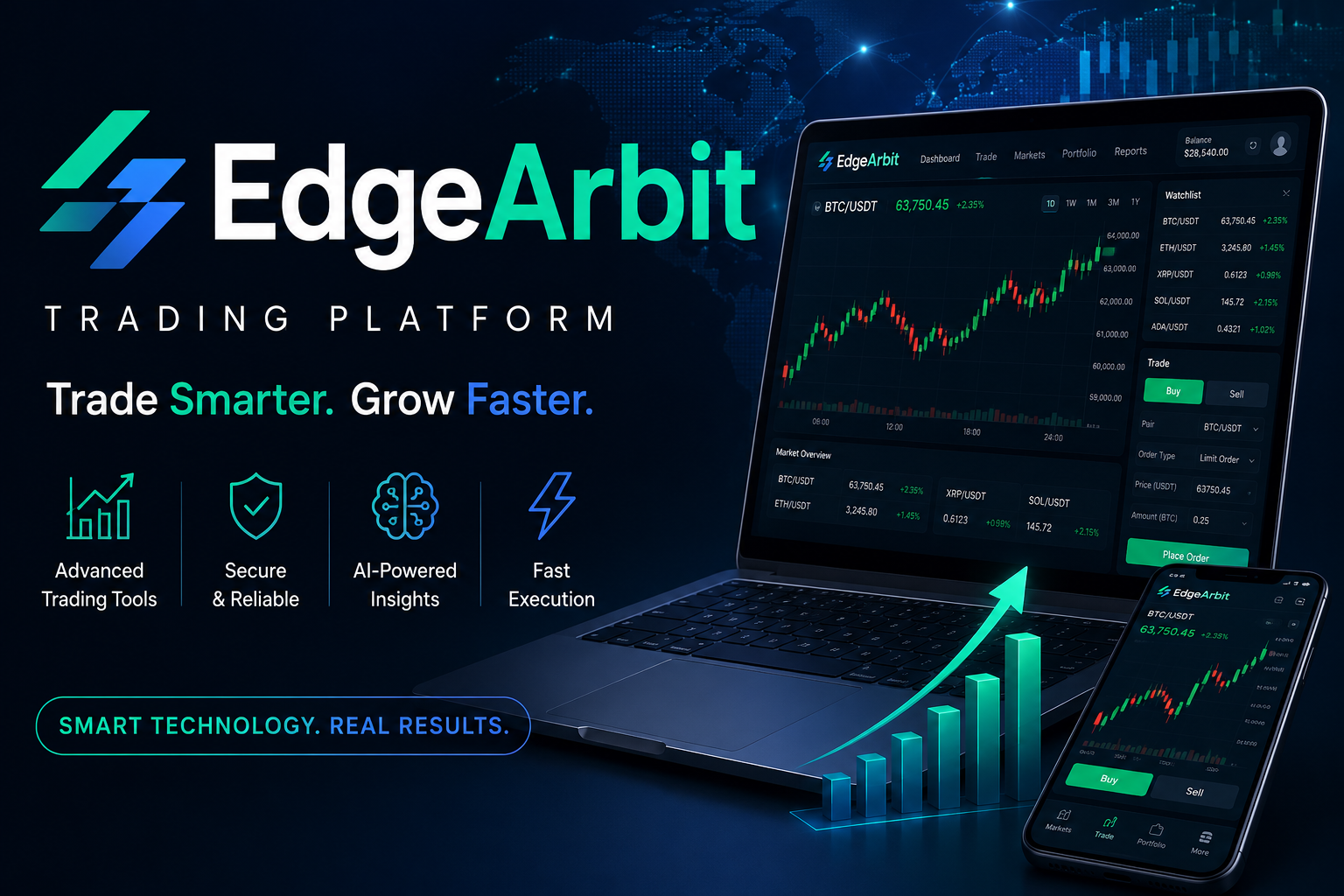
Among the emerging tools designed to democratize high-speed cross-exchange trading is EdgeArbit. Designed as an automated crypto trading platform focused on latency reduction, liquidity routing, and spread capture, EdgeArbit attempts to bridge the gap between complex quantitative strategies and accessible user interfaces.
Launch Your EdgeArbit Account and Start Tracking Cross-Exchange Spreads Today
What is EdgeArbit? Platform Architecture and Core Philosophy
At its core, EdgeArbit is a dedicated crypto arbitrage and algorithmic trading platform designed to automate the detection and execution of market inefficiencies. Unlike conventional spot exchanges that operate as isolated liquidity silos, EdgeArbit functions as an execution aggregator and automated trading engine. It connects to major centralized exchanges (CEXs) and decentralized exchanges (DEXs) via high-speed Application Programming Interfaces (APIs) and smart contract routers.
       +-------------------------------------------------------+
       |                  EdgeArbit Engine                     |
       |  +-------------------------------------------------+  |
       |  |     Multi-Exchange Order Book Aggregator        |  |
       |  +-------------------------------------------------+  |
       |                           |                           |
       |       +-------------------+-------------------+       |
       |       |                                       |       |
       |       v                                       v       |
       |  +-------------------------+     +-----------------+  |
       |  |   Real-Time Spread      |     |  Execution &    |  |
       |  |   Detection Matrix      |     |  Order Routing  |  |
       |  +-------------------------+     +-----------------+  |
       +-------------------------------------------------------+
                           |               |
              +------------+               +------------+
              | (REST / WebSockets)                     | (RPC / Web3)
              v                                         v
   +---------------------+                  +---------------------+
   | Centralized Venues  |                  | Decentralized AMMs  |
   | (Binance, OKX, etc.)|                  | (Uniswap, Curve)    |
   +---------------------+                  +---------------------+
The Three Pillars of EdgeArbit Architecture
-
Low-Latency Spread Detection Matrix:
EdgeArbit continuously scans hundreds of spot, perpetual futures, and decentralized liquidity pools. By ingesting real-time WebSocket tick data from supported exchanges, the engine models order book depth, bid-ask spreads, and slippage curves to identify profitable price divergences before they normalize.
-
Non-Custodial API Integration:
Security is a primary point of failure in algorithmic trading platforms. EdgeArbit utilizes a non-custodial operational architecture for its centralized exchange connections. Users link their existing exchange accounts via API keys with strict permission hierarchies: Trade Execution is enabled, while Withdrawal permissions are strictly disabled. Capital remains in the user’s exchange account until an order is triggered.
-
Automated Multi-Leg Order Execution:
When a qualifying arbitrage spread is detected, EdgeArbit does not rely on human reflexes. Its execution engine submits simultaneous buy and sell orders across the target venues, minimizing leg-risk (the danger that one side of the trade fills while the other fails due to rapid price shifts).
How Crypto Arbitrage Works on EdgeArbit
To understand how EdgeArbit extracts value from crypto markets, one must examine the mathematics of transaction economics. An arbitrage opportunity is only viable if the gross price spread exceeds the cumulative costs of execution, which include:
EdgeArbit’s algorithmic filters automatically discard opportunities where the spread fails to clear a user-defined profit threshold after factoring in these friction costs.
Key Trading Strategies Executed by EdgeArbit
A. Cross-Exchange Spot Arbitrage (Spatial Arbitrage)
The most direct form of arbitrage occurs when identical trading pairs are mispriced across two different centralized exchanges.
-
Example: Bitcoin (BTC/USDT) trades at $62,400 on Exchange A due to local selling pressure, while simultaneously trading at $62,650 on Exchange B due to aggressive spot buying.
-
Execution: EdgeArbit instantly fires a buy limit/market order on Exchange A while executing an equivalent sell order on Exchange B. Once the market prices converge, the trader rebalances their inventory or settles the net stablecoin profit.
B. Triangular Arbitrage (Single-Exchange Intra-Pair Trading)
Triangular arbitrage exploits pricing inefficiencies between three different cryptocurrency pairs on the same exchange, eliminating the need to transfer funds between different platforms or manage inter-exchange latency.
-
Example: On a single exchange, a trader starts with USDT, buys Bitcoin (USDT $\rightarrow$ BTC), trades that Bitcoin for Ethereum (BTC $\rightarrow$ ETH), and finally sells the Ethereum back into USDT (ETH $\rightarrow$ USDT).
-
Execution: If the cross-rate between BTC/ETH does not perfectly reflect the individual USDT spot prices of both assets, EdgeArbit executes all three trades in a millisecond loop, returning a larger USDT balance than the starting principal.
C. Decentralized vs. Centralized (DEX-to-CEX) Arbitrage
Decentralized exchanges rely on algorithmic pricing formulas ($x \cdot y = k$) rather than traditional order books. When a large market participant (a “whale”) executes a massive swap on a DEX like Uniswap, it temporarily imbalances the liquidity pool, causing the DEX price to lag behind or overshoot centralized exchange spot prices.
-
Execution: EdgeArbit monitors on-chain mempools and decentralized liquidity pools. When a DEX price deviates from CEX order books, the platform buys the discounted asset on-chain and sells it on a centralized exchange (or vice versa), capturing the spread while restoring market equilibrium.
Deploy Automated Arbitrage Bots with Zero Manual Coding on EdgeArbit
Deep-Dive: Core Features and Technical Capabilities
EdgeArbit differentiates itself from basic retail trading bots by incorporating institutional-grade execution tools designed for capital efficiency and risk mitigation.
1. Unified Multi-Exchange Dashboard
Managing multiple exchange accounts often forces traders to fragment their attention across dozens of open browser tabs and mobile apps. EdgeArbit provides a single terminal where users can view aggregate portfolio valuations, open limit orders, historical execution logs, and real-time yield charts across all connected CEX and DEX accounts.
2. Algorithmic Bot Customization and Templates
For traders without Python or C++ programming backgrounds, EdgeArbit offers a visual strategy builder alongside pre-built template strategies. Users can deploy algorithmic bots by defining specific operational parameters:
-
Minimum Spread Threshold: Set the minimum percentage divergence required to trigger an order (e.g., only execute if the net spread is $\ge 0.45\%$).
-
Maximum Trade Allocation: Limit the amount of capital deployed per arbitrage leg to control slippage and exposure.
-
Gas Price Ceiling: For on-chain DEX strategies, set a maximum Gwei limit to prevent unprofitable trades during periods of high blockchain congestion.
3. High-Speed Latency Optimization
In arbitrage, execution speed is the primary competitive moat. EdgeArbit positions its routing infrastructure near major cloud exchange servers (such as AWS Tokyo and AWS Ireland, where exchanges like Binance and OKX host their matching engines). This physical co-location and optimized network routing reduce API ping times, increasing the fill probability for competing arbitrage orders.
4. Comprehensive Backtesting and Paper Trading Engine
Before risking capital in live spot or derivative markets, users can test their arbitrage rules against historical tick data. EdgeArbit’s backtesting engine simulates order fills, historical slippage, and fee tier schedules, allowing traders to see how a specific strategy would have performed during historical volatile market events.
Account Setup, Verification, and API Integration Guide
Setting up EdgeArbit requires a methodical approach to ensure operational security and API synchronization. Below is a complete walkthrough for onboarding onto the platform and configuring your first automated arbitrage bot.
Step 1: Account Creation and Security Hardening
-
Navigate to the official EdgeArbit web portal and initialize a new trading account.
-
Complete the initial email and identity verification protocols required by the platform’s security framework.
-
Mandatory Security Step: Immediately activate Two-Factor Authentication (2FA) using a time-based one-time password (TOTP) application such as Google Authenticator, YubiKey, or Authy. Never rely solely on SMS verification for trading infrastructure.
Step 2: Generating Exchange API Keys
To allow EdgeArbit to trade on your behalf without holding your funds, you must create dedicated API keys from your preferred centralized exchanges (e.g., Binance, Bybit, Kraken, Coinbase Advanced):
-
Log into your exchange account and navigate to the API Management section.
-
Click Create New API Key and assign it a recognizable label (e.g.,
EdgeArbit-Spot-Bot-01). -
Configure Permissions:
-
Enable Reading / Account Info:
YES(Allows EdgeArbit to read balances and monitor order statuses). -
Enable Spot & Margin Trading:
YES(Allows EdgeArbit to place and cancel buy/sell orders). -
Enable Withdrawals:
ABSOLUTELY NO(Never enable withdrawal permissions on third-party trading APIs).
-
-
IP Whitelisting (Optional but Recommended): If EdgeArbit provides dedicated static IP addresses for your tier, bind your exchange API keys exclusively to those IPs to prevent unauthorized execution from external servers.
       [ Exchange Account: Binance / Kraken / Bybit ]
                           |
            (Generate API Key & Secret Key)
                           |
      +--------------------+--------------------+
      |                                         |
      v                                         v
 [Read Balances: ON]                 [Spot Trading: ON]
      |                                         |
      +--------------------+--------------------+
                           |
               (Withdrawal Access: OFF)
                           |
                           v
        [ Securely Connect to EdgeArbit Engine ]
Step 3: Connecting APIs to EdgeArbit
-
Open your EdgeArbit dashboard and navigate to Exchange Connections.
-
Select your exchange from the integration menu.
-
Paste your API Key and Secret Key into the encrypted fields.
-
Run a connection test. Once verified, your exchange balances will reflect inside the EdgeArbit unified dashboard.
Step 4: Configuring and Launching Your First Arbitrage Strategy
-
Go to the Strategy Studio and select an operational template (e.g., Cross-Exchange Stablecoin/BTC Arbitrage).
-
Set your Risk Parameters:
-
Max Capital Usage per Trade: Set to a conservative limit (e.g., 5% to 10% of your available USDT/USDC balance).
-
Target Spread: Set a realistic minimum threshold (e.g.,
0.35%net profit after fees).
-
-
Activate the bot in Paper Trading Mode for 48 hours to evaluate fill efficiency and order tracking before switching to Live Execution Mode.
Connect Your Exchange APIs and Automate Your Arbitrage Strategy Now
Risk Management: Mitigating Pitfalls in Crypto Arbitrage
While arbitrage is structurally marketed as a “market-neutral” trading strategy—because the trader is not taking a long or short directional bet on where Bitcoin or Ethereum will move next—it is not risk-free. Successful quantitative traders on EdgeArbit must actively manage operational, structural, and network risks.
                       +-----------------------------------+
                       |    Arbitrage Risk Taxonomy        |
                       +-----------------------------------+
                                         |
         +-------------------------------+-------------------------------+
         |                               |                               |
         v                               v                               v
+------------------+           +------------------+            +------------------+
|    Leg Risk      |           |  Slippage Risk   |            |  Withdrawal &    |
|                  |           |                  |            |  Transfer Risk   |
+------------------+           +------------------+            +------------------+
| - One order      |           | - Thin order     |            | - Exchange wallet|
|   fills; the     |           |   books cause    |            |   freezes or     |
|   other fails    |           |   worse prices   |            |   network halts  |
| - Exposure to    |           |   than the       |            |   during asset   |
|   price swings   |           |   quoted spread  |            |   rebalancing    |
+------------------+           +------------------+            +------------------+
1. Leg Risk (Execution Latency)
The most common hazard in cross-exchange arbitrage is Leg Risk (also known as execution lag). This occurs when your buy order successfully executes on Exchange A, but the sell order on Exchange B fails to execute because the price spread vanished before the API request arrived.
-
The Result: You are left holding an unplanned directional long or short position in a volatile asset.
-
Mitigation: Use EdgeArbit’s automated Leg-Protection Orders, which immediately fire a market-order kill switch to liquidate the completed leg if the corresponding second leg fails to execute within a specified millisecond window.
2. Slippage and Liquidity Depth
A price spread shown on a chart does not guarantee profitability if the order book lacks sufficient volume. If an arbitrage opportunity shows a 1.5% price gap between two exchanges, but only $500 worth of liquidity sits at the top of the order book, attempting to execute a $10,000 order will push the price against you, eroding the spread through slippage.
-
Mitigation: Always calibrate your bot’s maximum order size to represent a minor fraction (e.g., $\le 15\%$) of the typical top-of-book depth for that specific cryptocurrency pair.
3. Rebalancing and Transfer Latency
In spatial cross-exchange arbitrage, executing continuous trades eventually drains your stablecoin balance on the buying exchange and accumulates excess crypto on the selling exchange. To keep trading, you must periodically rebalance accounts by withdrawing tokens across blockchains.
-
The Risk: Network congestion or exchange-level withdrawal maintenance can trap capital in transit for hours, preventing your bots from capturing new opportunities.
-
Mitigation: Utilize high-speed, low-fee transport layers such as Arbitrum, Optimism, Solana, or Tron (TRC-20) when moving stablecoins or collateral between connected exchanges.
EdgeArbit vs. Traditional Crypto Trading Platforms
To evaluate where EdgeArbit fits within the broader cryptocurrency software landscape, it is helpful to compare its functional specialization against general-purpose crypto exchanges and standard grid-trading bots.
| Feature / Metric | EdgeArbit | Conventional CEXs (Binance, Coinbase) | Standard Trading Bots (Grid / DCA) |
| Primary Trading Focus | Cross-Exchange & Intra-Exchange Arbitrage | Directional Spot, Margin, and Futures Trading | Trend-Following, Dollar-Cost Averaging, & Grid Traps |
| Market Exposure | Primarily Market-Neutral (Delta-Neutral) | Directional (Long / Short Risk) | Directional (Long-Biased in typical DCA setups) |
| Custody Framework | Non-Custodial (Connects via read/trade API keys) | Custodial (User deposits funds directly into exchange vaults) | Can be either custodial or API-based non-custodial |
| Execution Latency | Optimized for millisecond spread capture | Standard matching engine speeds | Low-to-medium speed (minute/hour candle executions) |
| Profit Mechanism | Captures price differentials across books | Capital appreciation via price speculation | Captures volatility within preset price ranges |
| Hardware Required | Cloud-based execution engine (No local rig required) | Browser or Mobile App | Requires VPS or cloud hosting for continuous uptime |
Why Market-Neutral Strategies Stand Out in Bear Markets
During protracted bear markets or extended periods of sideways consolidation, directional crypto traders struggle to generate consistent returns without taking on excessive leverage risk. Arbitrage platforms like EdgeArbit operate independently of broader market sentiment; as long as trading volume and volatility create temporary price dislocations between exchanges, spread capture remains viable regardless of whether Bitcoin is trending toward all-time highs or consolidating at cycle lows.
Explore Market-Neutral Trading Bots and Optimize Your Crypto Execution
Frequently Asked Questions (FAQ)
What is the minimum capital required to start trading on EdgeArbit?
While EdgeArbit does not enforce a strict hardware or account balance minimum to test its software, mathematical arbitrage requires sufficient capital to overcome exchange trading fees and blockchain gas costs. Generally, deploying less than $500 to $1,000 per connected exchange account can result in net returns being consumed by fixed exchange base fees and withdrawal costs during rebalancing.
Is EdgeArbit safe to use with my main exchange accounts?
EdgeArbit operates on a non-custodial API model. Because users explicitly disable Withdrawal Permissions when generating API keys on exchanges like Binance, Kraken, or Bybit, the platform cannot transfer funds out of your accounts. However, users should always practice good cyber hygiene: use unique passwords, enable 2FA on all endpoints, and regularly rotate exchange API keys.
Do I need to keep my computer running 24/7 for EdgeArbit to trade?
No. EdgeArbit runs its automated trading strategies on decentralized cloud infrastructure and co-located servers. Once you configure your strategy parameters and activate your bot, execution happens server-side. You can close your browser or turn off your mobile device without interrupting ongoing arbitrage monitoring.
Can EdgeArbit trade decentralized exchanges (DEXs) like Uniswap or PancakeSwap?
Yes, EdgeArbit supports decentralized liquidity pool arbitrage where users can monitor price divergences between automated market makers (AMMs) and centralized spot order books. Operating in DEX environments requires users to maintain a self-custodial Web3 wallet (e.g., MetaMask, Rabby, or WalletConnect integrations) funded with native gas tokens (ETH, BNB, SOL) to cover smart contract execution fees.
How are trading fees calculated when using EdgeArbit?
Trading fees consist of two separate components:
-
Exchange Execution Fees: The standard maker/taker fees charged directly by your connected exchanges (e.g., 0.08% to 0.10% per spot trade).
-
Platform Tier / Performance Fees: Depending on your EdgeArbit subscription tier, the platform may charge a monthly software access fee or a small percentage-based performance fee on profitable arbitrage executions.
Conclusion: Who Should Use EdgeArbit?
The cryptocurrency market is transitioning from an era of easy directional speculation into a mature, quantitative trading environment. As liquidity deepens across centralized and decentralized venues, the window for capturing manual price spreads has effectively closed. Modern arbitrage requires institutional-grade infrastructure, automated API routing, and disciplined risk management.
EdgeArbit provides a structured, user-accessible gateway into automated arbitrage and market-neutral crypto trading. By combining multi-exchange API aggregation with latency-optimized execution engines and visual strategy customization, it allows active traders to participate in cross-exchange spread capture without requiring proprietary coding infrastructure.
-
For Algorithmic & High-Frequency Traders: EdgeArbit streamlines the execution loop, providing clean API connectivity and leg-risk mitigation across global liquidity centers.
-
For Active Crypto Investors: The platform offers a systematic, delta-neutral method for deploying capital, generating yield from market inefficiencies rather than relying purely on bullish price action.
Before deploying substantial capital, traders should thoroughly backtest their strategies, utilize paper trading modes to understand spread dynamics, and maintain conservative risk limits to account for liquidity slippage and execution lag.
Get Started with EdgeArbit: Unlock Multi-Exchange Automated Trading Today