
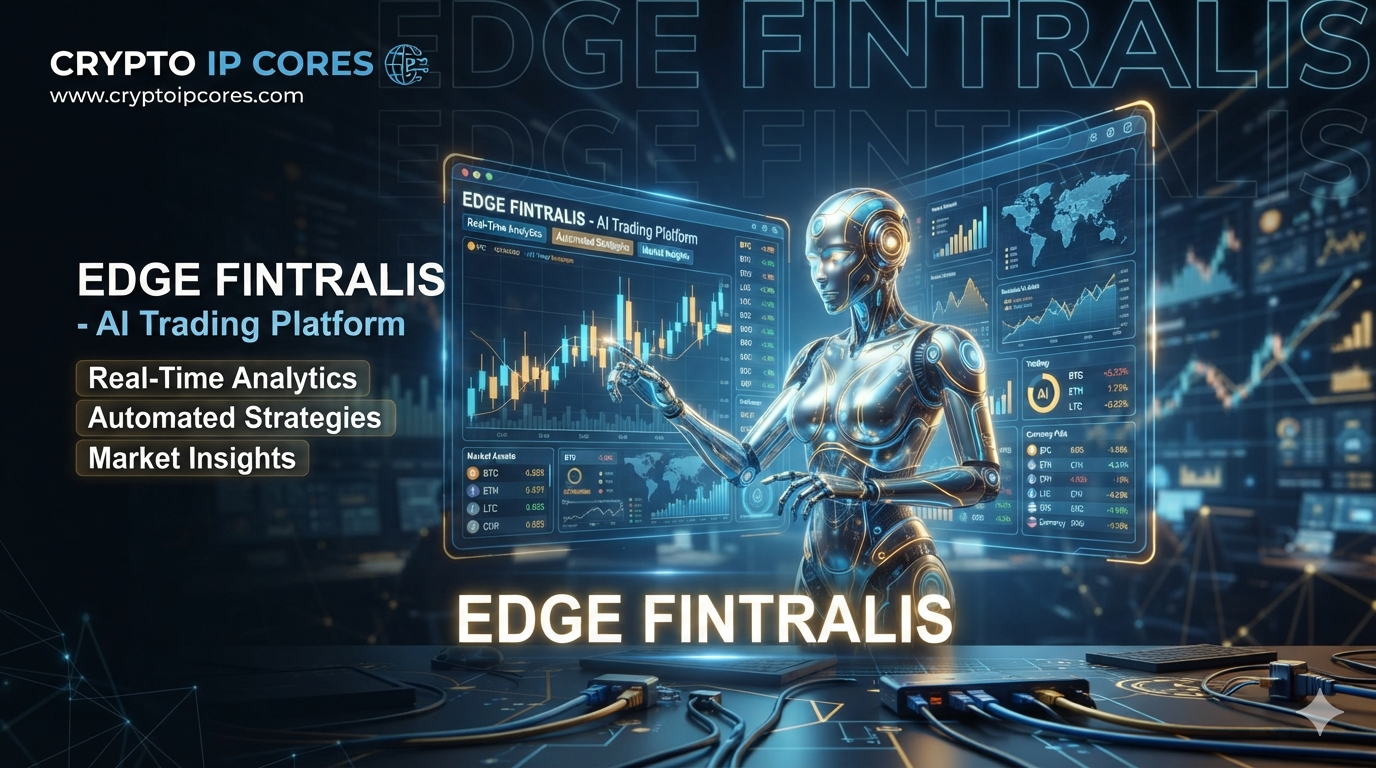
The cryptocurrency trading landscape is currently undergoing a massive paradigm shift. We have moved far beyond the days of manually drawing trendlines, watching basic moving averages, and frantically refreshing CoinMarketCap. The modern bull and bear cycles are dictated by high-frequency algorithmic bots, deep-learning market scanners, and institutional quantitative easing. For the average retail trader, competing against Wall Street-grade infrastructure can feel like bringing a knife to a gunfight.
Enter Edge Fintralis—a web-based, AI-driven trading ecosystem that is aggressively leveling the playing field. Positioned as a bridge between complex algorithmic execution and user-friendly accessibility, Edge Fintralis claims to distill billions of data points into actionable, automated strategies.
But with the internet flooded by vaporware and overhyped “AI money printers,” the burden of proof is high. Does this platform genuinely utilize machine learning to map out market inefficiencies, or is it just another reskinned signal group?
🚀 Activate Your Edge Fintralis AI Bot – Start Trading
What Exactly is Edge Fintralis?
At its core, Edge Fintralis is a browser-based algorithmic trading platform. Unlike traditional centralized exchanges (CEXs) that merely provide the liquidity and the order book (think Binance or Coinbase), Edge Fintralis operates as an intelligent overlay. It is designed to act as your co-pilot in the markets, constantly scanning for volatility, volume spikes, and historical price patterns.
The platform was built to solve a critical pain point in the Web3 space: time decay and emotional fatigue. Day trading crypto is a 24/7 endeavor. The markets never close, and a flash crash at 3:00 AM can liquidate a portfolio while the trader sleeps. Edge Fintralis addresses this by offering customizable automation—allowing the AI to execute trades based on pre-set parameters when human supervision is impossible.
The Browser-First Architecture
One of the most notable engineering choices behind Edge Fintralis is its completely web-based infrastructure. There are no heavy desktop clients to download and no localized software that requires constant patching. The platform runs entirely in the cloud, utilizing optimized node routing to ensure low-latency order execution regardless of the device you are using. Whether you are on a high-end trading rig or a mid-range smartphone, the UI scales flawlessly.
The Core Engine: How Edge Fintralis Utilizes AI
“Artificial Intelligence” is the ultimate buzzword of the current market cycle, often slapped onto basic linear regression models. However, the engine under the hood of Edge Fintralis operates on a much more sophisticated spectrum, combining several layers of quantitative analysis.
Real-Time Pattern Recognition
The software consumes massive amounts of historical tick data. It doesn’t just look for simple double tops or head-and-shoulders patterns; it analyzes complex, multi-timeframe fractal geometries. When current price action aligns with a historically proven setup with a high probability of mean reversion or breakout, the system flags it.
Sentiment and On-Chain Analysis
Price action is only half the battle. In crypto, narrative and sentiment drive capital rotation. Edge Fintralis integrates sentiment analysis tools that track social volume, exchange inflows/outflows, and whale wallet movements. If a massive amount of Bitcoin (BTC) is suddenly moved onto spot exchanges (a historically bearish signal indicating intent to sell), the AI incorporates this into its real-time risk assessment, potentially dialing back long exposure.
Volatility-Adjusted Execution
Not all market conditions are created equal. A strategy that dominates during an altcoin season (high volatility, high liquidity) will bleed you dry during a crab market (low volatility, sideways chop). The Edge Fintralis AI dynamically adjusts its stop-loss and take-profit algorithms based on the Average True Range (ATR) and implied volatility of the specific asset.
🤖 Claim Your Edge Fintralis Demo Account Today
The Dual-Mode Ecosystem: Manual vs. Automated
Edge Fintralis understands that handing the keys to an AI bot requires immense trust—trust that must be earned. To accommodate traders at all ends of the risk spectrum, the platform operates in two distinct modes.
Hands-On Support (The Co-Pilot Mode)
For seasoned traders who want to maintain ultimate authority over their capital, the manual mode acts as an advanced intelligence feed. The AI acts as a sophisticated screener, sending real-time alerts.
-
Example: The AI detects a massive divergence on the MACD indicator on the Ethereum (ETH) 4-hour chart, combined with declining sell volume. It pushes a notification outlining the setup, the suggested entry zone, and recommended risk parameters. The trader then reviews the data and manually clicks “Execute” or ignores the signal entirely.
Streamlined Automation (The Algorithmic Mode)
For those who want to detach entirely from the screens, the automated mode takes over the heavy lifting. Traders input their strict boundaries:
-
Maximum daily drawdown percentage.
-
Specific asset allocations (e.g., 60% Bitcoin, 20% Solana, 20% Forex pairs).
-
Trading session limits.
Once these guardrails are established, the platform handles the entries, manages the trailing stops, and scales out of positions at predetermined profit targets without human intervention.
Multi-Asset Dominance: Beyond Just Crypto
While the platform heavily leans into Web3 and decentralized assets, one of its greatest strengths is its cross-market functionality. Diversification is the only free lunch in investing, and forcing traders to maintain separate accounts across different brokers for different asset classes is antiquated.
Edge Fintralis allows users to deploy capital across 7+ distinct asset categories from a single unified dashboard:
| Asset Class | Coverage Examples | Strategy Application |
| Cryptocurrency | BTC, ETH, SOL, altcoins | High volatility scaling, 24/7 automated momentum bots. |
| Forex | EUR/USD, GBP/JPY, Exotics | Mean-reversion bots leveraging deep global liquidity pools. |
| Equities | Tech stocks, index funds | Earnings report volatility plays and long-term algorithmic DCA. |
| Commodities | Gold, Silver, Crude Oil | Macro-economic hedging against crypto exposure. |
This holistic approach means that if crypto enters a multi-month consolidation phase, your automated bots can be seamlessly rotated into trending Forex or Commodity markets to keep capital compounding.
The $250 Entry Point: Democratizing Algorithmic Trading
Historically, gaining access to quantitative trading algorithms required high-net-worth status, passing rigorous accredited investor checks, or paying thousands of dollars a month for Bloomberg Terminal subscriptions.
Edge Fintralis has deliberately set a low barrier to entry: a $250 minimum deposit.
This is a highly strategic number. It is low enough to be accessible to retail traders globally, but high enough to filter out spam accounts and ensure users have enough starting capital to actually deploy proper risk management. (Trading with $10 makes position sizing mathematically impossible when factoring in basic slippage and fees).
🛡️ Step Into the Future of AI Trading – Register Here
Getting Started: The Onboarding Flow
Starting with algorithmic trading can be intimidating, but Edge Fintralis has streamlined the process to take less than 15 minutes from registration to your first simulated trade.
Deep Dive: Risk Management and Capital Preservation
The golden rule of crypto trading isn’t “make as much money as possible.” It is “protect your principal at all costs.” Edge Fintralis incorporates several non-negotiable risk management tools that traders must utilize to survive market turbulence.
Hard Stop-Losses and Dynamic Trailing Stops
A static stop-loss is basic; it closes your trade when a specific price is hit. Edge Fintralis utilizes dynamic trailing stops. If an AI bot enters a long position on Solana at $100 and it pumps to $120, the system automatically drags the stop-loss up to a secure level (e.g., $115). This guarantees that a winning trade will never turn into a losing trade, mathematically locking in profits as the asset trends upwards.
Position Sizing Calculators
The platform actively discourages “all-in” degenerate behavior. The AI defaults to a fractional risk model, meaning it will rarely risk more than 1% to 2% of the total account equity on a single algorithmic setup. This ensures that even a string of consecutive losses (which happens to every system) results in negligible overall drawdown, preserving capital for the high-probability setups.
⚡ Automate Your Crypto Gains – Join Edge Fintralis Now
Security Architecture: Is Edge Fintralis Safe?
In a post-FTX world, trust is earned through verifiable security architecture, not marketing jargon. Edge Fintralis implements several layers of institutional-grade security to protect user data and funds.
-
Multi-Factor Authentication (MFA): Mandatory for all account logins, withdrawals, and changes to API settings. Time-based One-Time Passwords (TOTP) through Google Authenticator or Authy are heavily recommended over SMS.
-
End-to-End Encryption: All data transmitted between your browser and the Edge Fintralis servers is secured via AES-256 encryption, the standard used by global banks.
-
KYC and AML Protocols: While privacmaximalists may balk at KYC, it is an absolute necessity for platform longevity. By rigorously screening users, Edge Fintralis prevents the platform from being used for illicit money laundering, significantly reducing the risk of regulatory crackdowns that could freeze user funds.
-
Segmented Server Architecture: Trading algorithms and execution engines are hosted on completely separate servers from user databases, minimizing the attack surface for potential bad actors.
Analyzing User Sentiment and Verifiable Feedback
When analyzing the legitimacy of a trading platform, looking at aggregated user data is crucial. Based on compiled data from trusted review aggregators like Trustpilot, Edge Fintralis maintains a highly competitive 4.5 to 4.8 out of 5 rating.
What Users Praise:
-
Time Recapture: The most common theme in five-star reviews is the sheer amount of time saved. Traders no longer feel the need to stare at 1-minute charts for 12 hours a day.
-
Mobile Experience: Because it is entirely browser-based and heavily optimized, users report executing complex bot recalibrations seamlessly from their smartphones during their morning commute.
-
The Demo Environment: Beginners heavily praise the paper-trading feature, noting that it allowed them to build confidence in the AI without burning through their initial $250 deposit due to “fat-finger” errors.
What Users Critique (The Honest Nuance):
-
Slight Execution Lag During Extreme Volatility: During massive market-moving events (like an unexpected Federal Reserve interest rate hike), a few users noted slight latency in signal delivery. This is common across almost all retail platforms when API endpoints get saturated, but it is worth noting for high-frequency scalpers.
-
Learning Curve for Advanced Automation: While the basic setup is easy, creating highly specific, multi-layered algorithmic conditions requires a solid understanding of market mechanics. The AI is a tool, not a magic wand.
Educational Infrastructure: Building Better Traders
A platform is only as good as the traders using it. Rather than relying solely on the AI to act as a black box, Edge Fintralis heavily invests in user education.
The platform features an expansive learning hub containing:
-
Video Tutorials: Walkthroughs on how to read market depth, understand liquidity sweeps, and configure the AI bots for different market regimes (trending vs. ranging).
-
Market Briefings: Daily and weekly macroeconomic summaries detailing how traditional finance (TradFi) events might impact Web3 asset prices.
-
Strategy Documentation: Transparent breakdowns of why the AI makes certain decisions, turning the platform into a live educational tool rather than just an execution engine.
🔒 Secure Your Multi-Asset Portfolio on Edge Fintralis
Pros and Cons: A Fair Assessment
No trading platform is perfect, and Edge Fintralis is no exception. Here is the unvarnished breakdown of its strengths and limitations.
The Pros:
-
Advanced Analytical Edge: Brings institutional-grade pattern recognition to the retail trader.
-
Extreme Asset Diversification: The ability to trade crypto, forex, and equities natively from one account eliminates capital fragmentation.
-
Flawless UI/UX: The browser-based approach is lightweight, clean, and highly responsive on mobile.
-
Accessible Entry: The $250 minimum deposit is highly competitive.
-
Robust Security: Strong encryption, MFA, and KYC compliance ensure a stable ecosystem.
The Cons:
-
Not a “Set and Forget” System: Markets are dynamic. Leaving a bot running unattended for months without re-evaluating the macroeconomic environment will likely result in losses.
-
Inherent Market Risk: No AI can predict black swan events (e.g., a major exchange collapse). The AI manages risk, but it cannot eliminate market exposure.
-
Regional Restrictions: Regulatory compliance means the platform may not be fully functional or available in certain jurisdictions with hostile crypto legislation.
Final Verdict: Should You Use Edge Fintralis?
In a market saturated with over-promising trading bots and complex interfaces, Edge Fintralis carves out a highly compelling niche. It successfully bridges the gap between deep-learning algorithmic analysis and retail-friendly usability.
For the beginner, the comprehensive demo accounts, educational hubs, and strict risk-management guardrails provide a safe sandbox to understand market mechanics without immediate catastrophic risk.
For the veteran trader, the ability to offload the psychological burden of trade execution to an unemotional AI—while maintaining the ability to tweak the parameters—is invaluable. The multi-asset coverage further cements it as a primary dashboard for modern investors looking to diversify away from purely crypto-centric volatility.
Ultimately, Edge Fintralis is an incredibly powerful tool. It will not magically print money without user oversight, but if you treat it with discipline, utilize the risk management parameters, and continuously learn, it provides a distinct, quantifiable edge in the hyper-competitive arena of 2026 digital asset trading.